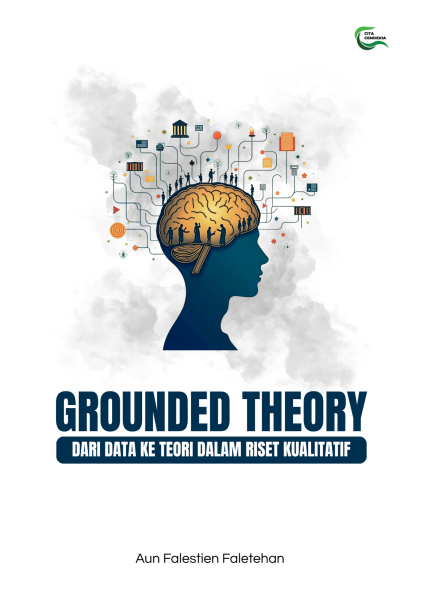
Grounded Theory: Dari Data ke Teori Dalam Riset Kualitatif
Keywords:
Grounded Theory, Data, KualitatifSynopsis
Apakah teori benar-benar lahir dari data atau justru dipaksakan ke dalamnya? Di tengah maraknya penelitian kualitatif yang mengklaim menggunakan grounded theory, hanya sedikit yang benar-benar mempraktikkannya secara konseptual dan metodologis. Terlalu sering, grounded theory direduksi menjadi sekadar teknik coding, kumpulan istilah metodologis, atau label yang ditempelkan di akhir penelitian. Akibatnya, esensi utamanya perlahan menghilang: bahwa teori seharusnya tumbuh dari data, bukan dipaksakan ke dalamnya. Buku ini lahir dari kegelisahan tersebut. Ia mengajak pembaca untuk melihat grounded theory bukan sekadar sebagai metode, tetapi sebagai cara berpikir—bahkan sebagai sikap epistemologis dalam memahami realitas sosial. Di sini, penelitian tidak dimulai dari kepastian, melainkan dari keterbukaan; tidak dari teori yang mapan, melainkan dari keberanian untuk mendengarkan data. Melalui pembahasan yang sistematis namun reflektif, buku ini menuntun pembaca menelusuri proses grounded theory dari fondasi konseptual, desain penelitian, analisis data, hingga konstruksi teori. Lebih dari sekadar panduan teknis, buku ini menunjukkan bagaimana teori dibangun secara bertahap melalui interaksi yang intens dengan data, hingga menghasilkan penjelasan yang benar-benar grounded. Pada akhirnya, buku ini adalah sebuah ajakan: untuk kembali pada data, mempertanyakan teori, dan membangun pengetahuan yang lebih jujur terhadap realitas. Karena dalam grounded theory, teori yang baik bukanlah teori yang paling elegan―melainkan teori yang paling setia pada data.
Downloads
References
Ainsworth, Susan, and Cynthia Hardy. "Critical Discourse Analysis and Identity: Why Bother?" Critical Discourse Studies 1, no. 2 (October 2004): 225-59. https://doi.org/10.1080/1740590042000302085.
Ajzen, Icek. "The Theory of Planned Behavior." Organizational Behavior and Human Decision Processes 50, no. 2 (December 1991): 179-211. https://doi.org/10.1016/0749-5978(91)90020-T.
Alajami, Abdulla. "Beyond Originality in Scientific Research: Considering Relations among Originality, Novelty, and Ecological Thinking." Thinking Skills and Creativity 38 (September 2020): 100723. https://doi.org/10.1016/j.tsc.2020.100723.
Alase, Abayomi. "The Interpretative Phenomenological Analysis (IPA): A Guide to a Good Qualitative Research Approach." International Journal of Education and Literacy Studies 5, no. 2 (2017): 9-19. https://doi.org/10.7575/aiac.ijels.v.5n.2p.9.
Alejandro, Audrey, and Longxuan Zhao. "Multi-Method Qualitative Text and Discourse Analysis: A Methodological Framework." Qualitative Inquiry 30, no. 6 (2024): 461-73. https://doi.org/10.1177/10778004231184421.
Allen, Lise M. "A Critique of Four Grounded Theory Texts." The Qualitative Report 15, no. 6 (November 2010): 1606-20.
Andrews, Tom, and Alvita Nathaniel. "Awareness of Dying Remains Relevant after Fifty Years." Grounded Theory Review: An International Journal 14, no. 2 (2015).
Bargal, David. "Action Research: A Paradigm for Achieving Social Change." Small Group Research 39, no. 1 (2008): 17-27.
Bernard, H. Russell. Research Methods in Anthropology: Qualitative and Quantitative Approaches. 4th ed. Lanham: Altamira Press, 2006.
Birks, Melanie, Karen Hoare, and Jane Mills. "Grounded Theory: The FAQs." International Journal of Qualitative Methods 18 (2019): 1-7. https://doi.org/10.1177/1609406919882535.
Bleakley, Alan. "Stories as Data, Data as Stories: Making Sense of Narrative Inquiry in Clinical Education." Medical Education 39, no. 5 (2005): 534-40. https://doi.org/10.1111/j.1365-2929.2005.02126.x.
Borman, Kathryn M., Margaret D. Lecompte, and Judith Preissle Goetz. "Ethnographic and Qualitative Research Design and Why It Doesn't Work." American Behavioral Scientist 30, no. 1 (1986): 42-57. https://doi.org/10.1177/000276486030001006.
Bott, Esther. "Favourites and Others: Reflexivity and the Shaping of Subjectivities and Data in Qualitative Research." Qualitative Research 10, no. 2 (April 12, 2010): 159-73. https://doi.org/10.1177/1468794109356736.
Bradbury, Hilary. "Action Research: An Opportunity for Revitalizing Research Purpose and Practices." Qualitative Social Work 2, no. 2 (2003): 155-75.
Bridgman, Todd, Stephen Cummings, and John Ballard. "Who Built Maslow's Pyramid? A History of the Creation of Management Studies' Most Famous Symbol and Its Implications for Management Education." Academy of Management Learning and Education 18, no. 1 (2019): 81-98. https://doi.org/10.5465/amle.2017.0351.
Brink, Pamela J., and Nancy Edgecombe. "What Is Becoming of Ethnography?" Qualitative Health Research 13, no. 7 (2003): 1028-30. https://doi.org/10.1177/1049732303253542.
Bryant, Antony, et al. The SAGE Handbook of Current Developments in Grounded Theory. Edited by Antony Bryant and Kathy Charmaz. Los Angeles: SAGE Publication, 2019.
Bryman, Alan. "Integrating Quantitative and Qualitative Research: How Is It Done?" Qualitative Research 6, no. 1 (2006): 97-113. https://doi.org/10.1177/1468794106058877.
Buckley, Charles A., and Michael J. Waring. "Using Diagrams to Support the Research Process: Examples from Grounded Theory." Qualitative Research 13, no. 2 (2013): 148-72. https://doi.org/10.1177/1468794112472280.
Burg, Elco Van, et al. "Advancing Qualitative Entrepreneurship Research: Leveraging Methodological Plurality for Achieving Scholarly Impact." Entrepreneurship: Theory and Practice 46, no. 1 (2022): 3-20. https://doi.org/10.1177/1042258720943051.
Caine, Vera, Andrew Estefan, and D. Jean Clandinin. "A Return to Methodological Commitment: Reflections on Narrative Inquiry." Scandinavian Journal of Educational Research 57, no. 6 (2013): 574-86.
Carmichael, Teresa, and Natalie Cunningham. "Theoretical Data Collection and Data Analysis with Gerunds in a Constructivist Grounded Theory Study." Electronic Journal of Business Research Methods 15, no. 2 (2017): 59-73.
Charmaz, Kathy. Constructing Grounded Theory: A Practical Guide through Qualitative Analysis. London: SAGE Publication, 2006.
Charmaz, Kathy. "Grounded Theory in Global Perspective: Reviews by International Researchers." Qualitative Inquiry 20, no. 9 (2014): 1074-84.
Charmaz, Kathy. "The Power of Constructivist Grounded Theory for Critical Inquiry." Qualitative Inquiry 23, no. 1 (2017): 34-45.
Charmaz, Kathy. "'With Constructivist Grounded Theory You Can't Hide': Social Justice Research and Critical Inquiry in the Public Sphere." Qualitative Inquiry 26, no. 2 (2020): 165-76.
Charmaz, Kathy, and Linda Liska Belgrave. "Thinking about Data with Grounded Theory." Qualitative Inquiry 25, no. 8 (2019): 743-53.
Cheek, Julianne. "At the Margins? Discourse Analysis and Qualitative Research." Qualitative Health Research 14, no. 8 (2004): 1140-50.
Chesebro, James W., and Deborah J. Borisoff. "What Makes Qualitative Research Qualitative?" Qualitative Research Reports in Communication 8, no. 1 (2007): 3-14.
Cho, Ji Young, and Eun Hee Lee. "Reducing Confusion about Grounded Theory and Qualitative Content Analysis: Similarities and Differences." Qualitative Report 19, no. 32 (2014): 1-20.
Chun Tie, Ylona, Melanie Birks, and Karen Francis. "Grounded Theory Research: A Design Framework for Novice Researchers." SAGE Open Medicine 7 (2019): 1-8.
Clandinin, D. Jean. "Narrative Inquiry: A Methodology for Studying Lived Experience." Research Studies in Music Education 27, no. 1 (2006): 44-54.
Clandinin, D. Jean, Debbie Pushor, and Anne Murray Orr. "Navigating Sites for Narrative Inquiry." Journal of Teacher Education 58, no. 1 (2007): 21-35.
Clarke, Victoria, and Virginia Braun. "Thematic Analysis." The Journal of Positive Psychology 12, no. 3 (2017): 297-98.
Coghlan, David, and A. B. Rami Shani. "Roles, Politics, and Ethics in Action Research Design." Systemic Practice and Action Research 18, no. 6 (2005): 533-46.
Colombijn, Freek. "Editorial." Bijdragen Tot de Taal-, Land- En Volkenkunde 177, no. 2 (2021): 177-81.
Conlon, Catherine, et al. "'Emergent Reconstruction' in Grounded Theory: Learning from Team-Based Interview Research." Qualitative Research 15, no. 1 (2015): 39-56.
Conlon, Catherine, et al. "Confused About Theoretical Sampling? Engaging Theoretical Sampling in Diverse Grounded Theory Studies." Qualitative Health Research 30, no. 6 (2020): 947-59.
Corbin, Juliet M., and Anselm L. Strauss. Basics of Qualitative Research: Techniques and Procedures for Developing Grounded Theory. 3rd ed. Thousand Oaks, CA: SAGE Publication, 2008.
Corbin, Juliet M., and Anselm L. Strauss. Basics of Qualitative Research: Techniques and Procedures for Developing Grounded Theory. 4th ed. Los Angeles: Sage, 2015.
Corbin, Juliet M., and Anselm L. Strauss. "Grounded Theory Research: Procedures, Canons, and Evaluative Criteria." Qualitative Sociology 13, no. 1 (1990): 3-21.
Corley, Kevin G., and Dennis A. Gioia. "Building Theory about Theory: What Constitutes a Theoretical Contribution?" Academy of Management Review 36, no. 1 (2011): 12-32.
Creswell, John W. Research Design: Qualitative, Quantitative and Mixed Approaches. 3rd ed. Los Angeles: SAGE Publications, 2009.
Crotty, Michael. The Foundations of Social Research: Meaning and Perspective in the Research Process. 2nd ed. London: Sage, 2003.
Cunningham, Bart. "Action Research: Toward a Procedural Model." Human Relations 29, no. 3 (1976): 215-38.
Cypress, Brigitte S. "Qualitative Research: The 'What,' 'Why,' 'Who,' and 'How'!" Dimensions of Critical Care Nursing 34, no. 6 (2015): 356-61.
Denny, Elaine, and Annalise Weckesser. "How to Do Qualitative Research?" BJOG: An International Journal of Obstetrics & Gynaecology 129, no. 7 (2022): 1166-67.
Denzin, Norman. "Qualitative Analysis for Social Scientists: Book Review." Contemporary Sociology 17 (1988): 430-32.
Denzin, Norman. "The Art and Politics of Interpretation." In Handbook of Qualitative Research, edited by Norman Denzin and Y. S. Lincoln, 500-515. Thousand Oaks, CA: Sage, 1994.
Drapeau, Martin. "Subjectivity in Research: Why Not? But..." The Qualitative Report 7, no. 3 (2015): 1-15.
Draucker, Claire B., et al. "Theoretical Sampling and Category Development in Grounded Theory." Qualitative Health Research 17, no. 8 (2007): 1137-48.
Durgee, Jeffrey F. "Richer Findings from Qualitative Research." Journal of Advertising Research 26, no. 4 (1986): 36-44.
Eisenhardt, Kathleen M. "Building Theories from Case Study Research." The Academy of Management Review 14, no. 4 (1989): 532-50.
Eisenhardt, Kathleen M. "Making Fast Strategic Decisions in High-Velocity Environments." Academy of Management Journal 32, no. 3 (1989): 543-76.
Eisenhardt, Kathleen M., and Melissa E. Graebner. "Theory Building from Cases: Opportunities and Challenges." Academy of Management Journal 50, no. 1 (2007): 25-32.
Engward, Hilary. "Understanding Grounded Theory." Nursing Standard 28, no. 7 (2013): 37-41.
Erro-Garces, Amaya, and Jose A. Alfaro-Tanco. "Action Research as a Meta-Methodology in the Management Field." International Journal of Qualitative Methods 19 (2020): 1-11.
Faletehan, Aun Falestien. "Embracing Duality: Exploring the Synergy of Traditional and Religious HRM Practices to Enhance Volunteer Retention in Faith-Based Organizations." Human Service Organizations: Management, Leadership and Governance 48, no. 5 (2024): 649-66.
Faletehan, Aun Falestien, and Elco van Burg. "'We Will Not Pay You, but God Will Remunerate': The Paradox of Volunteer Transcendental Rewards in Faith-Based Organizations." Journal of Religion and Spirituality in Social Work 42, no. 2 (2023): 238-58.
Finn, John. Getting a PhD: An Action Plan to Help Manage Your Research, Your Supervisor and Your Project. London: Routledge, 2005.
Flick, Uwe. An Introduction to Qualitative Research. London: SAGE Publications, 2009.
Foley, Geraldine, et al. "Interviewing as a Vehicle for Theoretical Sampling in Grounded Theory." International Journal of Qualitative Methods 20 (2021): 1-10.
Garrido, Norman. "El Método de James Spradley En La Investigación Cualitativa." Enfermería: Cuidados Humanizados 6, no. Especial (2017): 37.
Gibbert, Michael, and Winfried Ruigrok. "The 'What' and 'How' of Case Study Rigor: Three Strategies Based on Published Work." Organizational Research Methods 13, no. 4 (2010): 710-37.
Gioia, Dennis A., Kevin G. Corley, and Aimee L. Hamilton. "Seeking Qualitative Rigor in Inductive Research: Notes on the Gioia Methodology." Organizational Research Methods 16, no. 1 (2013): 15-31.
Glaser, Barney G. "Conceptualization: On Theory and Theorizing Using Grounded Theory." International Journal of Qualitative Methods 1, no. 2 (2002): 23-38.
Glaser, Barney G. Doing Quantitative Grounded Theory. Mill Valley, CA: Sociology Press, 2008.
Glaser, Barney G. "Grounded Description: No No." In The SAGE Handbook of Current Developments in Grounded Theory, edited by Antony Bryant and Kathy Charmaz, 441-45. Los Angeles: SAGE Publication, 2019.
Glaser, Barney G. Jargoning: The Use of the Grounded Theory Vocabulary. Mill Valley, CA: Sociology Press, 2009.
Glaser, Barney G. "The Future of Grounded Theory." Qualitative Health Research 9, no. 6 (1999): 836-45.
Glaser, Barney G. Theoretical Sensitivity: Advances in the Methodology of Grounded Theory. Mill Valley, CA: Sociology Press, 1978.
Glaser, Barney G., and Anselm L. Strauss. The Discovery of Grounded Theory: Strategies for Qualitative Research. New Brunswick: Aldine Transaction, 1967.
Goldberg, Abbie E., and Katherine R. Allen. "Qualitative Family Research: Innovative, Flexible, Theoretical, Reflexive." Journal of Marriage and Family 86, no. 5 (2024): 1323-52.
Grant, Adam M., and Timothy G. Pollock. "From the Editors. Publishing in AMJ Part 3: Setting the Hook." Academy of Management Journal 54, no. 5 (2011): 873-79.
Gregor, Shirley. "The Nature of Theory in Information Systems." MIS Quarterly 30, no. 3 (2006): 611-42.
Hallberg, Lillemor R. M. "The 'Core Category' of Grounded Theory: Making Constant Comparisons." International Journal of Qualitative Studies on Health and Well-Being 1, no. 3 (2006): 141-48.
Hammersley, Martyn. "Conversation Analysis and Discourse Analysis: Methods or Paradigms?" Discourse & Society 14, no. 6 (2003): 751-81.
Hammersley, Martyn. "What Is Ethnography? Can It Survive? Should It?" Ethnography and Education 13, no. 1 (2018): 1-17.
Handwerker, W. Penn. "The Construct Validity of Cultures: Cultural Diversity, Culture Theory, and a Method for Ethnography." American Anthropologist 104, no. 1 (2002): 106-22.
Hastings, Annette. "Analysing Power Relations in Partnerships: Is There a Role for Discourse Analysis?" Urban Studies 36, no. 1 (1999): 91-106.
Hood, Jane C. "Orthodoxy vs. Power: The Defining Traits of Grounded Theory." In The Sage Handbook of Grounded Theory, edited by Antony Bryant and Kathy Charmaz, 151-64. Thousand Oaks, CA: Sage, 2007.
Horsford, Sonya Douglass, and Diana D'Amico. "The Past as More than Prologue: A Call for Historical Research." International Journal of Educational Management 29, no. 7 (2015): 863-73.
Hunter, Joshua E. "Towards a Cultural Analysis: The Need for Ethnography in Interpretation Research." Journal of Interpretation Research 17, no. 2 (2012): 47-58.
Keller, Reiner, and Kathy Charmaz. "A Personal Journey with Grounded Theory Methodology: Kathy Charmaz in Conversation with Reiner Keller." Forum Qualitative Sozialforschung 17, no. 1 (2016).
Kenny, Méabh, and Robert Fourie. "Contrasting Classic, Straussian, and Constructivist Grounded Theory: Methodological and Philosophical Conflicts." Qualitative Report 20, no. 8 (2015): 1270-89.
Kram, Kathy E., and Lynn A. Isabella. "Mentoring Alternatives: The Role of Peer Relationships in Career Development." Academy of Management Journal 28, no. 1 (1985): 110-32.
Laitinen, Heleena, Marja Kaunonen, and Päivi Åstedt-Kurki. "Methodological Tools for the Collection and Analysis of Participant Observation Data Using Grounded Theory." Nurse Researcher 22, no. 2 (2014): 10-15.
Lal, Shalini, Melinda Suto, and Michael Ungar. "Examining the Potential of Combining the Methods of Grounded Theory and Narrative Inquiry: A Comparative Analysis." Qualitative Report 17, no. 21 (2012): 1-22.
Larkin, Michael, Rachel Shaw, and Paul Flowers. "Multiperspectival Designs and Processes in Interpretative Phenomenological Analysis Research." Qualitative Research in Psychology 16, no. 2 (2019): 182-98.
Leach, James. "Historical Objectivity and Value Neutrality." Inquiry 11, no. 1-4 (1968): 349-67.
Ligita, Titan, et al. "From Textual to Visual: The Use of Concept Mapping as an Analytical Tool in a Grounded Theory Study." Qualitative Research 22, no. 1 (2022): 126-42.
Lindsay, Gail M., and Jasna K. Schwind. "Narrative Inquiry: Experience Matters." The Canadian Journal of Nursing Research 48, no. 1 (2016): 14-20.
Locke, Karen. Grounded Theory in Management Research. London: SAGE Publications, 2003.
Locke, Karen, and Karen Golden-biddle. "Constructing Opportunities for Contribution: Structuring Intertextual Coherence and 'Problematizing' in Organizational Studies." Academy of Management Journal 40, no. 5 (1997): 1023-62.
McCann, Terence V., and Eileen Clark. "Grounded Theory in Nursing Research: Part 2 Critique." Nurse Researcher 11, no. 2 (2003): 19-28.
Miles, Matthew B., and A. Michael Huberman. Qualitative Data Analysis. Thousand Oaks, CA: Sage, 1984.
Miller, Raissa M., Christian D. Chan, and Laura B. Farmer. "Interpretative Phenomenological Analysis: A Contemporary Qualitative Approach." Counselor Education and Supervision 57, no. 4 (2018): 240-54.
Miller, Steven I., and Marcel Fredericks. "How Does Grounded Theory Explain?" Qualitative Health Research 9, no. 4 (1999): 538-51.
Mills, Jane, Ann Bonner, and Karen Francis. "The Development of Constructivist Grounded Theory." International Journal of Qualitative Methods 5, no. 1 (2006): 25-35.
Morse, Janice M., et al. Developing Grounded Theory: The Second Generation. London: Routledge, 2016.
Muller, Michael J., and Sandra Kogan. Grounded Theory Method in HCI and CSCW. Cambridge: IBM Center for Social Software, 2010.
Murphy, Chad, Anthony C. Klotz, and Glen E. Kreiner. "Blue Skies and Black Boxes: The Promise (and Practice) of Grounded Theory in Human Resource Management Research." Human Resource Management Review 27, no. 2 (2017): 291-305.
Neilsen, Eric H. "But Let Us Not Forget John Collier: Commentary on David Bargal's 'Personal and Intellectual Influences Leading to Lewin's Paradigm on Action Research.'" Action Research 4, no. 4 (2006): 389-99.
Ng, Keith, and Stewart Hase. "Grounded Suggestions for Doing a Grounded Theory Business Research." Electronic Journal of Business Research Methods 6, no. 2 (2008): 155-70.
Parker, Lee D., and Bet H. Roffey. "Methodological Themes: Back to the Drawing Board: Revisiting Grounded Theory and the Everyday Accountant's and Manager's Reality." Accounting, Auditing & Accountability Journal 10, no. 2 (1997): 212-47.
Pickard, Alison Jane. "Historical Research." In Research Methods in Information, 167-78. London: Facet, 2018.
Pickard, Alison Jane. "Introduction." In Research Methods in Information, xv-xxii. London: Facet, 2007.
Prasad, P. "Symbolic Processes in the Implementation of Technological Change: A Symbolic Interactionist Study of Work Computerization." Academy of Management Journal 36, no. 6 (1993): 1400-1429.
Pratt, Michael. "From the Editors: For the Lack of a Boilerplate: Tips on Writing up (and Reviewing) Qualitative Research." Academy of Management Journal 52, no. 5 (2009): 856-62.
Qureshi, Henna A., and Züleyha Ünlü. "Beyond the Paradigm Conflicts: A Four-Step Coding Instrument for Grounded Theory." International Journal of Qualitative Methods 19 (2020): 1-10.
Retz, Tyson. "The Structure of Historical Inquiry." Educational Philosophy and Theory 49, no. 6 (2015): 606-17.
Robert Thornberg, and Ciarán Dunne. "Literature Review in Grounded Theory." In The SAGE Handbook of Current Developments in Grounded Theory, edited by Antony Bryant and Kathy Charmaz, 206-21. Los Angeles: SAGE Publication, 2019.
Robrecht, Linda C. "Grounded Theory: Evolving Methods." Qualitative Health Research 5, no. 2 (1995): 169-77.
Rupsiene, Liudmila, and Rasa Pranskuniene. "The Variety of Grounded Theory: Different Versions of the Same Method or Different Methods?" Social Sciences 4, no. 70 (2010): 7–19.
Ryan, Jane. "Uncovering the Hidden Voice: Can Grounded Theory Capture the Views of a Minority Group?" Qualitative Research 14, no. 5 (2014): 549-66.
Sardana, Nitish, et al. "Qualitative and Quantitative Research Methods." In Substance Use and Addiction Research, 65-69. Elsevier, 2023.
Sebastian, Kailah. "Distinguishing between the Types of Grounded Theory: Classical, Interpretive and Constructivist." Journal for Social Thought 3, no. 1 (2019): 1-9.
Slembrouck, Stef. "Explanation, Interpretation and Critique in the Analysis of Discourse." Critique of Anthropology 21, no. 1 (2001): 33-57.
Stake, Robert E. "Case Studies." In Handbook of Qualitative Research, edited by N. K. Denzin and Y. S. Lincoln, 236-47. Thousand Oaks, CA: Sage, 1994.
Starks, Helene, and Susan Brown Trinidad. "Choose Your Method: A Comparison of Phenomenology, Discourse Analysis, and Grounded Theory." Qualitative Health Research 17, no. 10 (2007): 1372-80.
Strauss, Anselm L., and Juliet M. Corbin. Basics of Qualitative Research: Techniques and Procedures for Developing Grounded Theory. 2nd ed. London: Sage Publications, 1998.
Suddaby, Roy, Garry D. Bruton, and Steven X. Si. "Entrepreneurship through a Qualitative Lens: Insights on the Construction and/or Discovery of Entrepreneurial Opportunity." Journal of Business Venturing 30, no. 1 (2015): 1-10.
Sutton, Robert I., and Barry M. Staw. "What Theory Is Not." Administrative Science Quarterly 40, no. 3 (1995): 371-84.
Tan, Jin. "Grounded Theory in Practice: Issues and Discussion for New Qualitative Researchers." Journal of Documentation 66, no. 1 (2010): 93-112.
The Grounded Theory Institute. "What Is Grounded Theory?" The Grounded Theory Institute, Mill Valley, CA, 2014.
Thomas, Sandra P., and Brian K. Sohn. "From Uncomfortable Squirm to Self-Discovery: A Phenomenological Analysis of the Bracketing Experience." International Journal of Qualitative Methods 22 (2023): 1-12.
Thompson Burdine, Julie, Sally Thorne, and Gurjit Sandhu. "Interpretive Description: A Flexible Qualitative Methodology for Medical Education Research." Medical Education 55, no. 3 (2021): 336-43.
Urcia, Ivan Aldrich. "Comparisons of Adaptations in Grounded Theory and Phenomenology: Selecting the Specific Qualitative Research Methodology." International Journal of Qualitative Methods 20 (2021): 1-14.
Urquhart, Cathy. "Grounded Theory's Best Kept Secret: The Ability to Build Theory." In The SAGE Handbook of Current Developments in Grounded Theory, edited by Antony Bryant and Kathy Charmaz, 89-106. Los Angeles: SAGE Publication, 2019.
Ven, Andrew H. Van de. "Nothing Is Quite so Practical as a Good Theory." Academy of Management Review 14, no. 4 (1989): 486-89.
Vollstedt, Maike, and Sebastian Rezat. "An Introduction to Grounded Theory with a Special Focus on Axial Coding and the Coding Paradigm." In Compendium Mathematics Researchers for Early Career Education, edited by Gabriele Kaiser and Norma Presmeg, 81-100. Cham, Switzerland: SpringerOpen, 2019.
Westberg, Johannes. "Historical Methods in Educational Research: Sources, Contextualisation, Periodisation and Analysis." Paedagogica Historica 61, no. 6 (2025): 994-1014.
Willems, E. P. "Planning a Rationale for Naturalistic Research." In Naturalistic Viewpoints in Psychological Research, 44-71. New York: Rinehart and Winston, Inc., 1969.
Williams, Sion, and John Keady. "Centre Stage Diagrams: A New Method to Develop Constructivist Grounded Theory - Late-Stage Parkinson's Disease as a Case Exemplar." Qualitative Research 12, no. 2 (2012): 218-38.
Yin, Robert K. Case Study Research: Design and Methods. Beverly Hills, CA: SAGE Publications, 1994.
Yoon, Bogum, and Christine Uliassi. "'Researcher-As-Instrument' in Qualitative Research: The Complexities of the Educational Researcher's Identities." The Qualitative Report (2022).